FTJF Goes Back to School

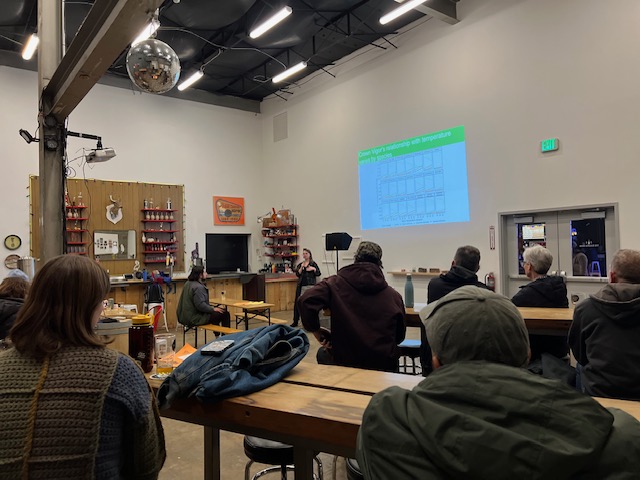
FTJF was invited to present aspects of environmental stewardship at the well-attended March 11th St. Paul’s Lower School STEM Fair. Thank you, STEM Director Nancy Dimitriades.

Stewardship Committee members Jessica Schue, Dick Williams and I demonstrated weed warrior work focused on non-native invasive (NNI) English ivy species removal. We brought a well-illustrated video about English ivy, prepared by Melissa Campanella, Stewardship Co-chair, as well as select landscaping tools and fresh-pruned cords of English ivy.

Engaging with students, parents and other family members, we explained how removing NNI vine and other harmful plant species is beneficial to trees and wildlife. Students were asked to draw pictures in response to the question: “How could removing vines help trees?” Their expressive drawings of trees (both sad-vined and happy-unvined), flowers and snails showed understanding and concern.

I found it interesting to hear stories from parents about how they were stewarding in their own backyards. They too struggle with NNI vines threatening their trees. We learned they are refusing to use chemical treatments on their landscapes in an effort to protect our streams as well as rejecting use of plastic bags and leaving turf grass high enough (min. 3”) to slow stormwater runoff into our waterways.

-Angie Plum, FTJF Stewardship Committee

“Stewarding our Urban Watersheds: A Conversation with Leading Clean Water Advocates in Baltimore”

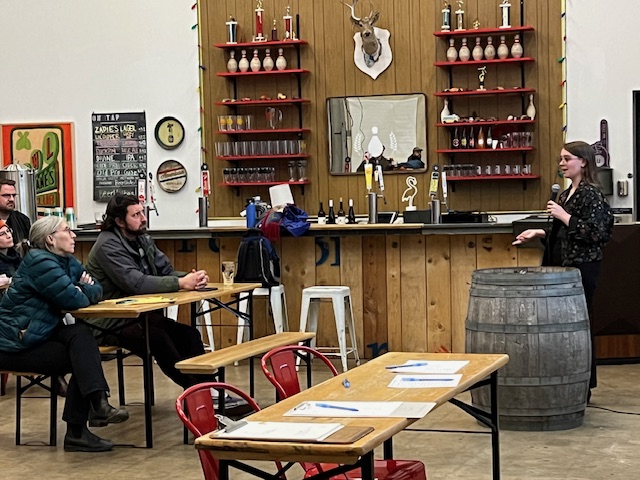
On the evening of March 21st a crowd gathered at The Peale museum in downtown Baltimore to attend a panel discussion on the human impact on the Jones Falls watershed, envisioning a more balanced, symbiotic future. The backdrop was the February-March 2025 exhibition, “The Future of Here: A Glimpse of a River Culture to Come.”

The panelists, led by exhibition co-organizer and environmental anthropologist Anand Pandian, included FTJF’s President, Sandy Sparks, and Board member and learning scientist, Melissa Campanella. Sarah Holter, Water Quality Program Manager, and John Marra, Community Program Manager, represented environmental non-profit Blue Water Baltimore. Sarah Koser, Chesapeake Bay Trust Grants Program Manager, and James Wolf, President of the Friends of Stony Run, rounded out the speakers. Exhibition co-organizer and visual artist Jordan Tierney also spoke from the audience.

From questions by Anand and audience members, each panelist shared personal and organizational testaments of challenges to and hopes for the Jones Falls watershed. Scarcity of resources and time, pollutants, invasive species and the looming threat of climate change were described as daunting challenges. But the panelists together offered resounding, hopeful reason for a prosperous Jones Falls ecosystem: the rich web of community.

Jordan and Melissa spoke to the beauty of the natural communities they see in our urban watersheds. Yellow-crowned night herons, hawks, foxes, fish, coyotes and humans are all neighbors in the urban watershed.

Jordan invited the crowd to see all living creatures, including plants, as more similar to than separate from ourselves. Both called for dissolving the manufactured barrier between the human and the natural world–so as to deepen our sense of hope in repairing and sustaining a thriving ecosystem of belonging in every part of every community.

-Sarah Holter, Blue Water Baltimore, Panelist

“Stewarding our Urban Watersheds: A Conversation with Leading Clean Water Advocates in Baltimore”

On the evening of March 21, 2025, a crowd gathered at The Peale museum in downtown Baltimore to attend a panel discussion on the human impact on the Jones Falls watershed, envisioning a more balanced, symbiotic future. The backdrop was the February-March 2025 exhibition, “The Future of Here: A Glimpse of a River Culture to Come.”

The panelists, led by exhibition co-organizer and environmental anthropologist Anand Pandian, included FTJF’s President, Sandy Sparks, and Board member and learning scientist, Melissa Campanella. Sarah Holter, Water Quality Program Manager, and John Marra, Community Program Manager, represented environmental non-profit Blue Water Baltimore. Sarah Koser, Chesapeake Bay Trust Grants Program Manager, and James Wolf, President of the Friends of Stony Run, rounded out the speakers. Exhibition co-organizer and visual artist Jordan Tierney also spoke from the audience.

From questions by Anand and audience members, each panelist shared personal and organizational testaments of challenges to and hopes for the Jones Falls watershed. Scarcity of resources and time, pollutants, invasive species and the looming threat of climate change were described as daunting challenges. But the panelists together offered resounding, hopeful reason for a prosperous Jones Falls ecosystem: the rich web of community.

Jordan and Melissa spoke to the beauty of the natural communities they see in our urban watersheds. Yellow-crowned night herons, hawks, foxes, fish, coyotes and humans are all neighbors in the urban watershed.

Jordan invited the crowd to see all living creatures, including plants, as more similar to than separate from ourselves. Both called for dissolving the manufactured barrier between the human and the natural world–so as to deepen our sense of hope in repairing and sustaining a thriving ecosystem of belonging in every part of every community.

-Sarah Holter, Panelist, Blue Water Baltimore

“The Future of Here: A Glimpse of a River Culture to Come” at The Peale

“Streamglider,” 2024 – by Michelle Nazareth

The artist talks about “Streamglider”

FTJF Board members were given a guided tour of the exhibition, The Future of Here, at The Peale museum in downtown Baltimore in Spring, 2025. (The show closed at the end of March.)

Visitors were invited to-
“…reimagine our place along the Jones Falls River and the Chesapeake Bay in a distant future beyond our fossil-fueled present. Consider what local landscapes and cultures might look like in a time far beyond the Baltimore we know now. What artifacts might people of that future time produce, and how might they make creative use of the many things we leave behind?”

To read the summary of the exhibition’s ambitions, click here.

To read some of “Streamglider” artist Michelle Nazareth’s related background, click here.

-The Editors

Important 2024 Maryland Legislation Backed

With unanimous approval of the Board, President Sandy Sparks sent signed letters to Del. Marc Korman (D-16) and Sen. Brian Feldman (D-15) in support of the “Clean Water Justice Act of 2024” bills, HB1101/SB653, respectively. These bills strengthen Marylanders’ wetlands integrity rights in face of the recent Sackett vs. EPA Supreme Court decision weakening the Clean Water Act with respect to certain waterways across the nation. This legislation has “crossed over” both Chambers with a potential enactment date by 10/1/24. The whole of the HB letter may be read here. Note: we wrote about the Sackett Decision in the Fall 2023 issue, linked here.

The Board has also unanimously supported two other important environmental bills.

One is 2024 Maryland HB979, “Agriculture – Invasive Plant Species – Regulation (Biodiversity and Agriculture Protection Act).” This proposed legislation, which companion is SB915, would alter the regulatory approach to controlling invasive plant species, expanding the list of nonnative plants banned for sale in Maryland, and assessing plants for an invasive watch list. This legislation has “crossed over” both Chambers with a potential enactment date by 10/1/24. The whole of the HB letter may be read here.

The other is 2024 Maryland HB1358, “Natural Resources – Gwynns Falls State Park – Focus Group, Advisory Committee, and Report,” which proposes to preserve the key role of Baltimore City managing Gwynns Falls/Leakin Park, its 1,200-acre western stream valley park, while sustaining this magnificent natural and recreational resource with dedicated State Open Space funds as an authorized State Park Partnership Park. The whole of this HB letter may be read here. Its companion legislation is SB1183.

Photos from Jones Falls Celebrates Sen. Ben Cardin Event

Many thanks for supporting the highly successful Jones Falls Celebrates Senator Ben Cardin on September 7th at White Hall Mill. Enjoy browsing the photo gallery for the evening created by Tedd Henn, Side A Photography: Jones Falls Celebrates Sen Cardin 9-7-2023 photo gallery. Thanks to all our sponsors! See the slideshow from the evening below.

Celebrate Sen. Ben Cardin Event a Great Success!

The Friends of The Jones Falls gathered on Sep. 7th to honor the legendary Sen. Ben Cardin— the Inaugural Champion of the Jones Falls. WYPR “Midday” show host, Tom Hall, enthusiastically offered insight into the Senator’s dedication and persistence.

Delegate Regina T. Boyce (District 43A), Ex Officio FTJF Board Member, then formally introduced the Senator: “As he turns the page on this chapter of his life, we all wonder what he will do next.” His wife of 60 years, Myrna, could be heard retorting, “Yeah, I’d like to know too.” Laughter spread. Boyce continued, “Celebrating this effective, long-suffering, dedicated leader, especially a leader that supports and fights for our waterways, the environment, our natural resources, and our beloved Chesapeake Bay, we say a big thank you!”

Over 100 well-wishers offered Sen. Cardin a hearty round of applause for his decades of legislative service dedicated to clean water and environment protections, from the Maryland State House to the U. S. Senate. He reflected on the critical role of his home, the Jones Falls Valley, to the well-being of Baltimore, and the recent progress in environmental initiatives and funding by the Biden Administration. In presenting the first Champion of the Jones Falls award, Friends of The Jones Falls President Sandy Sparks recalled Sen. Cardin 20 years ago winning $1.5 million in Federal funding for Baltimore City to construct the first segment of the Jones Falls Trail from Penn Station along Falls Road to Wyman Park Drive.

The evening at Whitehall Mill’s Penguin Room was a huge success with everyone enjoying the raw oyster bar and other tasty hors d’oeuvres catered by True Chesapeake Oyster Co., the restaurant just a few steps down the hall. The bar featured a Sen. Cardin margarita welcome cocktail and beer and wine donated by Union Craft and area spirits shops.

Many thanks to our generous Whitehall Mill host, David Tufaro, and many Business Sponsors for their strong financial support. And, kudos to the Steering Committee: Chair Maggie McIntosh, Co-Chair Nan Rohrer, Dawna Cobb, Ethan Cohen, Carol Gram Davis, Kate Foster, Phil Lee, Mary Page Michel, Salem Reiner, Sandy Sparks and Matt Stegman.

Please link to great event photos for viewing and purchase here. Thanks to all who bought tickets and made contributions!

-Sandy Sparks, FTJF President

Celebrating the 2023 Juneteenth National Holiday: Briefly Looking Back at African American Life in the Jones Falls Valley

By Dick Williams, FTJF Membership VP

The Village of Cross Keys is nestled within the Jones Falls Valley, south of Northern Parkway off Falls Road in Baltimore City. Developed in the 1960s by James Rouse, it prospers today with shops, restaurants, offices, a hotel, and residential housing.

But, did you know there was a previous Cross Keys Village with a mostly African American population? It was situated along Falls Road just north of Cold Spring Lane, mostly on the east side, running north to Hillside Road and was one of a small number of African American enclaves dotting the landscape from Cold Spring Lane and well into Baltimore County.

Two Cross Keys Villages: One Black. One White by James Holecheck was published in 2004 about the two villages. Linked here is a short, 2003 Sun article reviewing the book.

“Just when Cross Keys began nobody knows…Probably the village sprang up coincidentally with Mount Washington (Washingtonville it was called then) and other little communities in the Jones Falls Valley, simply because it was near pure water and had good pastureland,” said Mrs. Charles Baker, one of the oldest residents of Cross Keys Village, in a 1909 Baltimore Sun interview quoted by Holechek. That would put its first settlement in the early 19th century around the opening of the 1810 Washington Mill, located along the Jones Falls in present-day Mt. Washington.

Holechek says the Cross Keys Inn opened in the late 18th century (on land now occupied by Baltimore Polytechnic/Western High School). The origin of the name Cross Keys Village is unclear. In the decades to come, the addition of railroads in the Jones Falls Valley such as the Baltimore & Susquehanna Railroad (later: the Northern Central Railway) in 1829 and the Parkton local of the Pennsylvania Railroad later that century, drew commercial traffic away from the Falls Turnpike Road that passed through Cross Keys. “The inns, taverns, blacksmith shops and four-wheeled wagons began to fade from the Jones Falls Valley. However, the Cross Keys Inn survived the reduction of commercial turnpike traffic and actually thrived as a tavern supported by the villagers, mill and foundry workers at nearby Woodberry, and quarrymen along the turnpike who stopped after work for drinking and sometimes disorderly activity,” Holechek writes.

From the turn of the 19th century, most of the 500 people who lived in Cross Keys Village were African American. Holechek writes: “In addition to the inn and homes, Cross Keys Village at its peak was comprised of two African American churches, a small hospital (probably a doctor’s office), three grocery stores, a dairy, a café, a park (White Oak Grove) and a public school for ‘colored children.’”

“There were many interesting things about life in the village,” resident Gertrude Harvey West told Holechek back in the early 2000s. “There were traditions, like Monday was for washing. Tuesday ironing, but stranger than that, on certain days of the week, every family in the village ate the same thing. As an example, every Thursday was cabbage day. Everyone had cabbage, stewed tomatoes, white potatoes and a meat…Saturday was bean soup. We’d buy a piece of fatback for fifteen cents and add the beans. On Sunday we had chicken. You could smell those days for miles.”

Our attention now turns briefly to Rev. James Aquilla Scott, Sr. (pictured above) and his family. Born in 1784, Rev. Scott founded St. John’s Chapel in 1833 in a log cabin structure in present-day Ruxton. His day job was as a master blacksmith and wheelwright for tradesmen driving horse-drawn wagons along Falls Turnpike Road. He lived 74 years. His enslaved father, Tobias, moved from the Eastern Shore after saving the life of his master who in turn manumitted Tobias and all his descendants. Tobias then took the last name Scott so as to get his freedom pass.

Pictured above are exterior and interior photos of the second St. John’s Chapel, built in 1886 under the direction of Rev. Edward Scott, a son of Rev. James Aquilla Scott. It is located just up the hill some from the site of the original log chapel where both enslaved people and freemen worshipped. (It burned down in 1876.) The third photo is of the chapel’s historical marker along Bellona Avenue. St. John’s was first named Bethel Episcopal Methodist Religious Society. On the Maryland Historical Trust website, it’s described as “a frame Gothic Revival gable-roofed structure with board-and-batten siding, stylized lancet windows, and Queen Anne decorative detailing, including fishscale shingles in the gables.” Two potbelly stoves provided heat, and interior lighting was mostly by three kerosene chandeliers raised and lowered through eyebolts in the ceiling. The chapel was listed on the National Register of Historic Places in 1982 at the height of restoration efforts shepherded by area residents.

St. John’s served the African-American communities of Cross Keys Village, Mt. Washington and Bare Hills (now a County historic district further up Falls Road) into the 1960s when it was finally closed to regular worship services. It’s located on Bellona Avenue near Dunlora Road in Ruxton, and has been opened several times a year for worship services since the National Register listing.

Aquilla Scott, as Rev. James Aquilla became known, was quite prosperous. He and his wife had 12 children. In 1833 he bought acreage in Bare Hills to build the log chapel and adjacent parsonage just upland of the Northern Central Railway right-of-way. Later he bought a larger tract of land on the other side of Falls Road so he could build several homes for his extended family before dying in 1858. The map represents what’s called the Scott Settlement Historic District, one of Baltimore County’s oldest African-American enclaves. 18 dots on the map represent the homes of his numerous generations of descendants, including several pictured here (in altered states from the original buildings).

Scott family descendants live in Bare Hills today, and their lore is still admired by other homeowners in the area.

Photo credits: Rev. Scott (Marie Scott Brown); Interior of St. John’s (Wikipedia); the Scott Settlement Historic District map (LakeRoland.org); the rest (the author)