
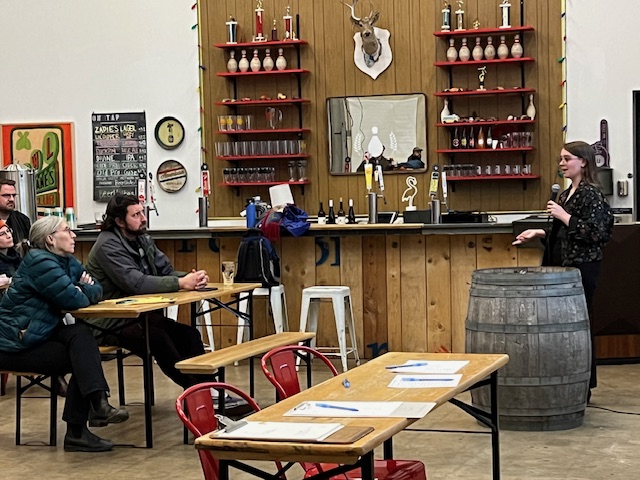
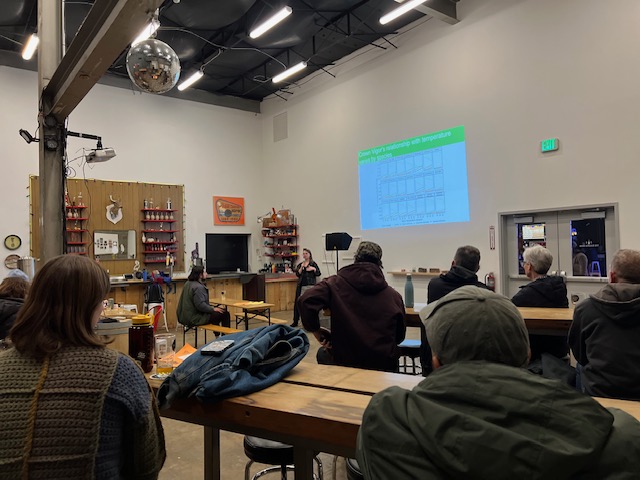
On December 3, 2025, Maggie Schaefer, a University of Maryland Master’s candidate in the Entomology Department, presented some of her research in city tree health to a crowd of enthusiasts at Union Craft Brewing.
Urban environments pose significant challenges to tree health, and climate change further complicates their growth and longevity. While newly planted trees, particularly in sidewalk tree pits, are often chosen with climate resilience in mind, the fate of established trees in increasingly hotter climatic conditions is less certain.
Maggie discussed the U. S. Forest Service’s Climate Change Tree Atlas which categorizes tree species based on adaptability and capability – the latter indicating projected health under future climate scenarios. Her team sampled key tree species across Baltimore, covering both cool and hot neighborhoods with input from the city’s Forestry division. They assessed tree health by measuring heat stress, signs of disease and environmental factors like tree pit size and insect presence.
The results showed that some species, such as Flowering dogwoods, struggled in all conditions, while others, like American lindens and Red oaks, are thriving citywide. Overall, areas with higher temperatures show poorer tree health for certain species like Silver maples and Willow oaks.
Maggie emphasized that a tree’s capability to manage temperature variability was the strongest predictor of health in changing climates, but maintaining species diversity remains critical for a resilient urban canopy. “Diversity is Resilience!” read one of her slides.
Heartfelt thanks to Maggie for sharing her excellent work, and to Union Craft Brewing for hosting this engaging event!
-Jessica Schue, Baltimore City TreeKeeper / FTJF Stewardship Weed Warrior
 Friends of The Jones Falls