If one were to ask a resident of Caves Valley, West Towson, Park Heights or Charles Village what watershed they live in, odds are that few would probably say the Jones Falls. Probably most would answer the Chesapeake Bay, due in large part to the Chesapeake Bay Foundation’s successful advocacy over almost 60 years.
Starting this Fall, the FTJF wants to create the same strong connection throughout the Jones Falls Watershed (or the Watershed) with a 2-year strategic plan initiative funded by the National Fish and Wildlife Foundation (NFWF). Visit the project website here.
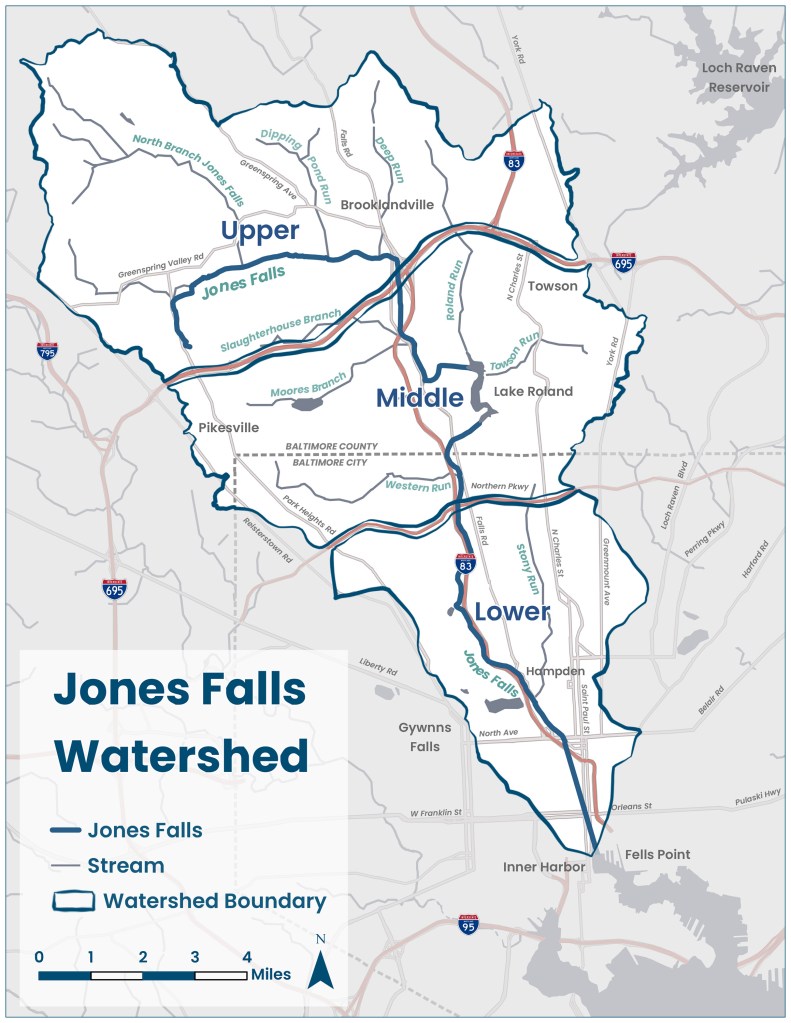
The Watershed is an 18-mile, 37,290-acre area that begins in pastoral northwest Baltimore County at Garrison Forest Rd. and extends as a degraded stream from the Baltimore City Line to the Inner Harbor by the Fallsway and Pier 6. In all, the watershed is home to over 230,000 people and mainly known for the areas around Lake Roland and further south along Falls Rd. Less well known are the major tributaries to its north and west including Deep Run, the North Branch and Moore’s Run and Western Run.
From its founding in 2018 by Sandy Sparks and other Jones Falls advocates, the FTJF organization recognized the need for a volunteer-based organization with the mission to support and sustain the quality of life and long-term stewardship of the Jones Falls in Baltimore City and County.
In 2024, to provide strategic guidance to its mission, the FTJF with Central Baltimore Partnership (CBP) applied for and received a highly competitive NFWF national planning grant of $149,750 to prepare a strategic plan for the entire Watershed. Previous studies of 10 or more years ago focused on water quality in connection with City and County Municipal Storm Sewer System MS4 goals, and were more limited to environmental monitoring and remediation recommendations.
The FTJF 2-year Strategic Plan will be more holistic and community-driven, focusing on environmental equity, climate resilience, public access and habitat restoration through land use and environmental best management practices.
We are hiring Biohabitats Chesapeake/Delaware Bays Bioregion, with offices in Clipper Mill, Baltimore City, as our environmental consultant for the whole watershed. Ashley Traut, Gaiacene Services, will be the NFWF Grant Manager. The planning process will be overseen by an overall Steering Committee. We are especially pleased that Sen. Ben Cardin, FTJF’s “Inaugural Champion of The Jones Falls,” agreed to serve as Honorary Chair.
The Steering Committee now includes:
Ben Cardin, U. S. Senator (Ret.) Honorary Chair
Al Barry, FTJF Board, AB Associates, Chair
Ellen Janes, CBP, Co-Chair
Sandy Sparks, FTJF Board President
Mac McComas, FTJF Board, Steering Committee Secretary, JHU 21st Century Cities Initiative
Ken Belt, Hydrologist, Maryland Natural History Society, UMBC Baltimore Ecosystem Study
Maggie McIntosh, Environmental Leader
Laurie Schwartz, Waterfront Partnership of Baltimore
Matt Stegman, Chesapeake Bay Foundation
Alice Volpitta, Blue Water Baltimore, Baltimore Harborkeeper
Ex Officio
Delegate Regina T. Boyce, FTJF Board
Delegate Sheila Ruth, FTJF Board
Delegate Dana Stein
The 2-year Strategic Plan is designed around three planning teams for the Upper, Middle and Lower & Inner Harbor sections of the Watershed. The Upper team will be based at the Irvine Nature Center and led by Brooks Paternotte, Executive Director. The Middle Team will be based at Park School and led by Julie Rogers, The Park School Baltimore Science faculty. Marian Glebes will chair the Lower & Inner Harbor Team with meetings at Baltimore Unity Hall.
Beginning this fall, each of these teams will coordinate and promote major Stakeholder Meetings, directed by Biohabitats, for community and environmental leaders, local and State partners. An important goal of the strategic plan will be to promote more cooperation and consistency between Baltimore City and County governments by updating existing efforts to be as holistic as possible and identifying policy changes and restoration opportunities that improve water quality, habitat diversity and environmental equity. At the conclusion of the study in the Fall 2027, the FTJF will sponsor a regional conference to present the Jones Falls Watershed findings.
Beginning in 1854 when Baltimore City essentially took over Lake Roland, followed by the 1904 Olmsted Brothers Report, “Development of Public Grounds for Greater Baltimore,” subsequent City Plans in 1919 and 1926 recognized the value of protecting each of the region’s watersheds. In 1961, the Greater Baltimore Committee prepared a detailed preservation plan for the Jones Falls Valley. City voters followed by approving a $2 million dollar bond that unfortunately was never implemented due to the City’s decision to build the Jones Falls Expressway over the stream.
Efforts have already begun to identify other past environmental studies, and also to complement ongoing reports by organizations such as Blue Water Baltimore. This strategic planning process will give residents and stakeholders of the region an understanding of the environmental interdependence of this expansive area—critical to their quality of life—and opportunities to provide diverse input over two years.
This will be an historic opportunity to participate in the Jones Falls Watershed Strategic Plan in both the City and County. We welcome and look forward to your help! A schedule of the initial extensive outreach efforts will be announced early this fall. I encourage you to contact me for updates and to follow Friends of The Jones Falls.
-Al Barry, FTJF Board Member, Jones Falls Strategic Plan Chair, ababalt@yahoo.com
 Friends of The Jones Falls