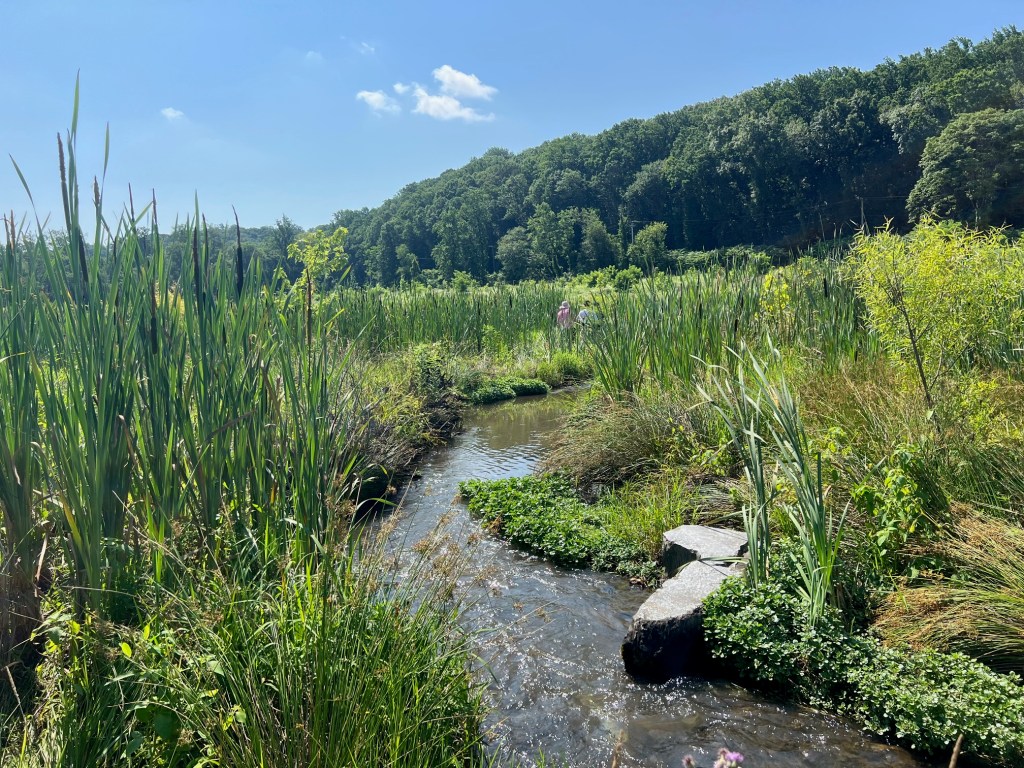
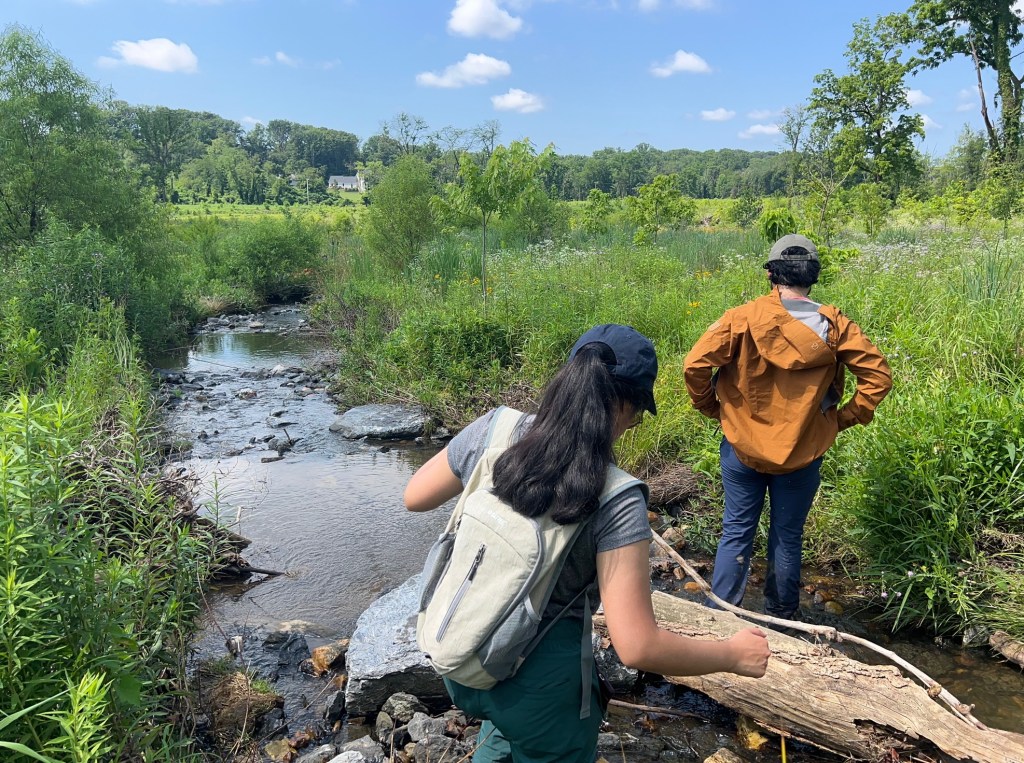

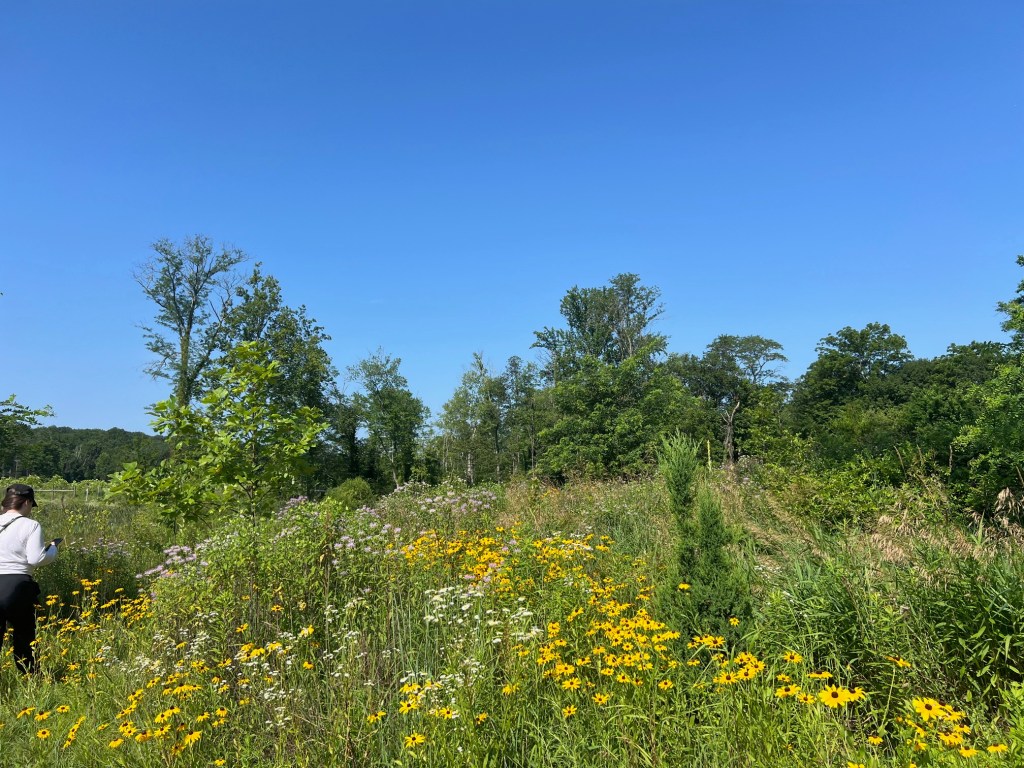
Some FTJF Board and Stewardship Committee members and a couple of others hiked recently in and around the Upper Jones Falls with an owner of the Eccleston Mitigation site in Baltimore County where more than 10,000 linear feet of the stream and 15 acres of wetlands have been reclaimed under a state conservation easement program six-plus years in the making.
Incidentally, the Jones Falls above Lake Roland (the Upper Jones Falls) is classified as Use III, meaning “non-tidal cold water.” It is “suitable for the support and protection of naturally reproducing trout populations.” From Lake Roland down to the Inner Harbor (the Lower Jones Falls), the stream is Use IV, meaning “recreational trout stocking waters.” This segment suggests suitability “for recreational activities related to trout, likely including fishing for stocked trout.” (Reference: Maryland DEP.)
The restoration actions accomplished are a big enhancement to habitat for non-native Brown trout and other wild fish living in the stream. For one, better flowing stream water leads to higher oxygen levels in the water. For another, a healthy flow of nutrients and organic matter through streams has a positive effect on natural food webs.
From contractor JMT’s “Projects” page: “The entire site was deforested as recently as 60 years ago according to historical aerial photos, and multiple buried tile locations were identified within the project limits as evidence of purposefully drained wetlands to increase tillable farmland. Additionally, emerald ash borer destroyed much of the green ash canopy on which the stream reach formerly depended upon for thermal regulation.”
Further: “The principal restoration design goal for the mitigation site was to restore and stabilize the brown trout fishery on the Upper Jones Falls. Approximately 30 years of data have identified that brown trout are decreasing in numbers as the water temperature warms due to watershed development and climate change. The fact that this stream flows from Baltimore County and through the center of Baltimore City, and provides the future potential for the brown trout population to increase within the city limits, make it a desirable project for Baltimore County and Baltimore City.”
15,000 trees and shrubs were planted in support of the stream restoration/floodplain reconnection project.
-The Editors
 Friends of The Jones Falls